Impact extrusion
Impact extrusion is a bulk metal forming process in which a press applies a high force to a workpiece, causing the confined material to flow. A blank is forced between tool components to produce individual formed parts.
What is impact extrusion?
Impact extrusion is a relatively young technology that was originally used to manufacture collapsible tubes made of lead and tin. While initially only non-ferrous metals could be processed using impact extrusion, the process has also been used to manufacture a wide range of steel components since the 1950s.
According to DIN 8582 and DIN 8583, impact extrusion belongs to the subgroup of extrusion processes within compressive forming. Depending on the direction of the machine movement and the resulting direction of material flow, a distinction is made between forward extrusion, backward extrusion and lateral extrusion.
Impact extrusion can be carried out either cold or warm. Heating reduces the flow stress of the material and increases its formability, thereby reducing the forming force required.
How does impact extrusion work?
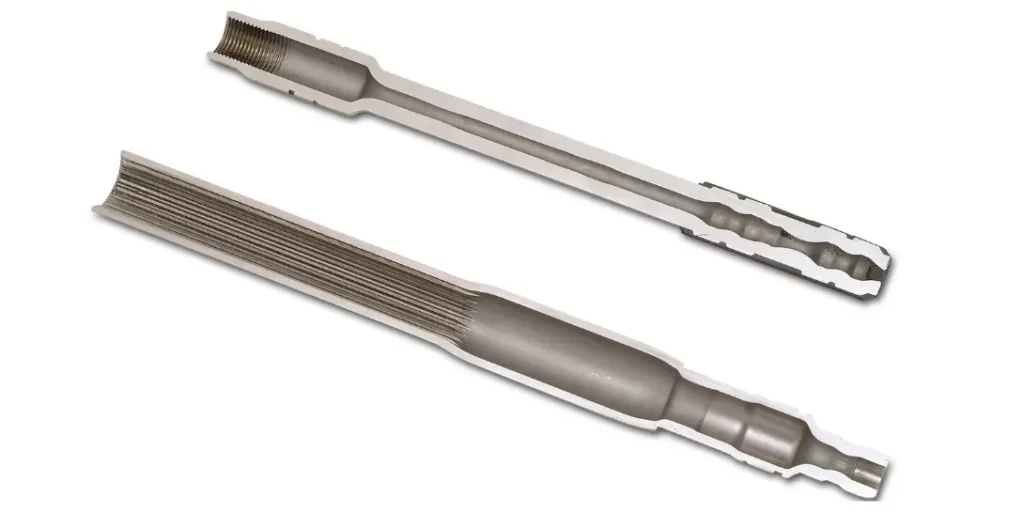
In impact extrusion, metal blanks are formed into hollow or solid components in a single-stage or multi-stage manufacturing process. A preformed metal blank, often a cylindrical billet, is placed in a press and forced through a specially shaped die under high pressure. The workpiece is enclosed by the die and punch. Once the applied pressure is sufficiently high, the material is forced to flow through the corresponding openings in the die.
More flexible than impact extrusion: axial forming and rotary swaging at Felss
While impact extrusion forces metal through a die to produce components with high strength and dimensional accuracy, Felss uses specialised cold forming processes such as rotary swaging and axial forming. These technologies enable the production of complex components with variable diameters using rotary swaging, as well as elongated and complex profiles using axial forming. Such components are particularly important in the automotive industry, medical technology and other highly specialised sectors.
Rotary swaging and axial forming allow precise control of component geometry, resulting in improved mechanical properties without the need for extensive post-processing. Their ability to process stronger materials that are more difficult to form also highlights the efficiency and sustainability of these processes.
Cold and hot impact extrusion – advantages and applications
Depending on the material and the required properties of the final product, impact extrusion can be performed as a cold, warm or hot forming process. The decisive factor is whether the blank has been heated above room temperature. In cold impact extrusion, the metal remains at room temperature, resulting in increased strength of the finished component through work hardening. In hot impact extrusion, the metal is heated before forming to improve its formability and/or reduce the forces required.
Cold impact extrusion: work hardening for increased strength
Impact extrusion at room temperature can cause work hardening. This increases the dislocation density within the crystal lattice, thereby improving the tensile strength and hardness of the finished component.
The process is particularly suitable for materials that have sufficient plastic formability and a low yield strength at room temperature. Cold-impact-extruded parts also frequently offer excellent surface quality and dimensional accuracy because the material is not heated.
Hot impact extrusion: lower forces and improved formability of hard materials
When the workpiece is heated before forming to improve its formability and reduce the forces required for the forming process, this is referred to as hot impact extrusion.
This process is frequently used for materials that are difficult to form when cold, including certain types of steel and alloys. Hot impact extrusion allows geometries to be produced with lower force requirements than cold impact extrusion. However, it generally results in lower surface quality and scale formation on the finished component.
Types of impact extrusion: geometry and direction of material flow
Impact extrusion is classified according to two main criteria: the geometry of the extruded components and the direction of material flow in relation to the main tool movement. This results in the following process variants.
Geometry of the extruded components
- Solid impact extrusion: In this process, the cross-section of the blank is not reduced by recesses or cavities. The entire material volume of the blank is involved in the forming process, producing solid and compact components.
- Hollow impact extrusion: This process produces components with internal cavities. The material is pressed around a mandrel, creating hollow components such as tubes, sleeves or containers.
- Cup impact extrusion: This is a specific type of hollow impact extrusion used to produce cup-shaped components with deep, hollow structures. The process is often used for products that require a deep and uniform geometry.
Direction of material flow
- Forward impact extrusion: In forward impact extrusion, the material flows in the same direction as the punch movement. This enables uniform material distribution and is particularly suitable for producing long, cylindrical components such as shafts and bolts.
- Backward impact extrusion: In backward impact extrusion, the material flows in the opposite direction to the punch movement. The process is suitable for components with complex internal structures because it provides greater control over material distribution. Typical applications include sleeves and containers with tight tolerances.
- Lateral impact extrusion: In lateral impact extrusion, the material flows perpendicular to the punch movement. This method is used to produce asymmetrical or non-cylindrical shapes and is particularly suitable for components with complex cross-sections and variable geometries.
Impact extrusion: the process and tooling
Impact extrusion is performed in several specific stages to transform a blank into a precise, high-quality workpiece. The basic steps include preparing the blank, setting up the press, carrying out the impact extrusion process, and removing and finishing the workpiece.
Preparing the blank
The first step in impact extrusion is selecting a suitable material for the component. The primary considerations are the required strength and ductility.
The shape and dimensions of the blank are adapted to the requirements of the impact extrusion process. Cylindrical blanks are frequently used and are produced by sawing or shearing thick wire or bar stock.
Depending on whether the process is performed cold, warm or hot, the blank either remains at room temperature or is preheated to improve its formability. Lubricating the components or applying a soap coating is also important at this stage to minimize friction during forming.
Setting up the press
A specially designed die is used for the extrusion process. It contains the openings through which the material is intended to flow. The die is installed in the press tool and reinforced to withstand the high internal pressures generated during forming.
The punch that forces the blank into the die is configured to transmit the force and movement of the press ram as effectively as possible. The die remains stationary while the punch is moved by the press.
Removing and finishing the component
After extrusion, the workpiece is removed from the die either manually or automatically. Quality control then checks the finished component for dimensional accuracy, surface finish and compliance with the specified requirements.
Typical components
A typical impact extrusion setup consists of several essential components: the punch, press sleeve, workpiece, holder, ejector, counterpunch, die and mandrel.
The force is generally applied through a rigid punch. In special cases, however, pressure media such as water or oil may also be used.
The processes can be performed at room temperature as cold impact extrusion or after preheating the blank as warm or hot impact extrusion. This allows the material properties and formability to be optimized.
Applications of impact extrusion
Because impact extrusion can produce complex geometries with high precision and smooth surfaces, it is used particularly in the automotive, electronics and medical technology industries.
Automotive industry
Transmission components, axles, hubs and bolts are just some examples of automotive components produced using impact extrusion.
These parts benefit from the high strength and durability achieved through cold forming. These properties are essential to the safety and service life of vehicle components.
Electronics industry
Impact-extruded components are also used in the electronics industry, particularly as precise metal housings for electronic components.
The precision of impact extrusion is important for the miniaturization of components that require high surface quality and dimensional accuracy. Examples include battery housings, sensor housings and heat sinks.
Medical technology
In medical technology, impact-extruded components are valued for their high precision and the ability to produce complex geometries.
Applications include instruments, housings for medical devices and implants, which benefit from the high strength and biocompatibility of components manufactured using impact extrusion.
Impact extrusion in summary
Impact extrusion is a solid forming process in which high pressure causes the material to flow and form different geometries.
The process is classified according to the geometry of the extruded components into solid, hollow and cup impact extrusion, and according to the direction of material flow into forward, backward and lateral impact extrusion.