What Sets Axial Forming Apart?
The automotive industry is undergoing a fundamental shift. Electrification, sustainability targets, and the demand for lighter, more efficient components are presenting suppliers with some of the toughest challenges in their history. Manufacturing technologies such as axial forming have an increasingly important role to play in meeting these demands.
One Technology, a Wide Range of Applications
Axial forming offers benefits far beyond automotive manufacturing. In precision engineering, aerospace, and many other industries, it combines the geometric accuracy needed for high-quality splines and gears with the speed required for efficient production.
At Felss, we have focused on developing technologies that help our customers use resources more efficiently and reduce their carbon footprint. Recent advances in axial forming now make it possible to produce helical gears, bringing these benefits to new applications and markets.
Supporting the Automotive Industry’s Transition
Manufacturers are under growing pressure to reduce the weight of drive shafts and other powertrain components while improving their performance. This is where rotary swaging and, in particular, axial forming demonstrate their value.
Although conventional machining remains more familiar to many manufacturers, these forming processes offer compelling advantages. They produce lighter components that can withstand higher loads, often in less time and at a lower cost.
At Felss, we believe that preparing for change starts with investing in the right technologies. Our commitment to research and strategic partnerships helps us address the challenges of electric mobility and alternative powertrains. It also enables us to support our customers as their markets and manufacturing requirements evolve.

How Does Axial Forming Work?
Axial forming is a cold forming process used to reduce the cross-section of tubes or bars and create defined profiles. Its most common application is the production of internal and external splines.
A forming tool—for example, a die with the inverse of the required spline profile—moves along the component’s axis. As it advances, it transfers its geometry precisely to the workpiece.
The process is suitable for both solid and hollow components, making it particularly useful for lightweight applications. There are two main approaches:
- Continuous axial forming: The tool advances at a constant speed.
- Recursive axial forming: The tool advances through a sequence of small forward strokes and shorter return movements. This reduces the forming forces and helps prevent unwanted upsetting of the workpiece.
Why Choose Axial Forming?
Axial forming combines high precision with efficient production. It can produce accurate spline profiles even on thin-walled components, with minimal pitch errors and close control over the finished geometry. These capabilities are particularly valuable in lightweight designs and applications where dimensional accuracy is critical.
Short cycle times and improved material properties add to its appeal. The following advantages explain why manufacturers choose axial forming for demanding components.
Precise, Complex Geometries
Axial forming produces complex profiles, including internal and external splines, directly on the component. Compared with cold extrusion and machining, it can offer greater geometric accuracy while reducing the need for subsequent finishing operations.
Because all teeth are formed simultaneously, the process achieves accuracy grades 5–6 according to DIN 5480. The result is a precise fit between mating components—a key requirement in demanding applications such as transmissions.
Shorter Cycle Times, Lower Production Costs
In series production, even small reductions in cycle time can make a significant difference.
Machining complex profiles often requires several operations and relatively long processing times. Axial forming can create these geometries in a single forming operation, shortening the production cycle and reducing manufacturing costs.
This combination of speed and efficiency makes the process particularly attractive for high-volume production.
Consistently High Spline Quality
Axial forming keeps pitch errors to a minimum. Unlike generating methods used to produce gears and splines, it uses a single-piece tool to form the entire tooth profile simultaneously.
This delivers highly accurate, consistent spline geometries, supporting reliable performance in transmissions and other applications subject to high loads.
More Efficient Use of Materials
Axial forming creates the required geometry by reshaping material rather than removing it. Compared with machining, this makes fuller use of the workpiece material and helps reduce waste and the associated CO₂ emissions.
The process can also offer material savings over cold extrusion in applications where trimming or other sources of scrap reduce overall material efficiency.
For manufacturers working to improve the environmental performance of their production processes, material utilization is an important part of the equation.
Preserved Grain Flow for Greater Fatigue Strength
Another important benefit is the preservation of the material’s grain flow. Keeping this structure intact improves fatigue strength and helps components withstand repeated loading.
This is especially valuable for safety-critical parts that need to perform reliably under demanding operating conditions.
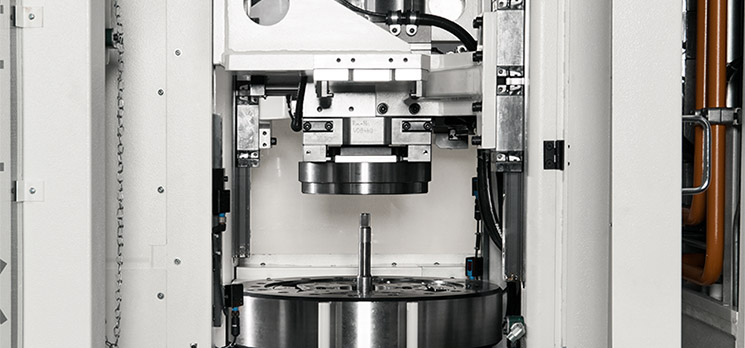
Why Axial Forming Matters to Felss
Our commitment to axial forming is grounded in practical experience. Every day, we see how it enables us to produce precise components at high volumes and with short cycle times.
These capabilities help us meet our customers’ requirements and develop new solutions for automotive manufacturing, industrial applications, precision engineering, and aerospace.
We also see axial forming as an important part of the future of manufacturing. Its combination of precision, productivity, and resource efficiency addresses many of the challenges our customers face as component requirements become more demanding.
Built for Demanding Components
Axial forming brings together several advantages in a single process: complex geometries, high dimensional accuracy, short cycle times, improved material properties, and excellent surface quality.
Together, these strengths make it well suited to the series production of components that must meet exacting standards for precision, strength, and surface finish.