


Humanoid robots – opportunity for industry or just hype?
Humanoid robots are currently one of the most discussed topics in the industry. While the automotive industry is in a transformation phase worldwide, many companies see humanoid robotics as a new strategic business area – both technologically and economically.
Market potential and growth
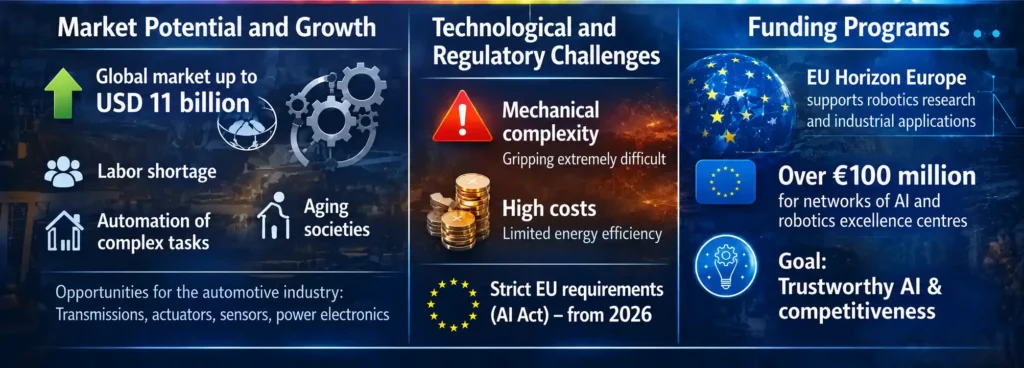
The market is still in its infancy, but is growing dynamically. The global market for humanoid robots was around USD 1.55 billion in 2024 and could grow to about USD 4.0 billion by 2030 (CAGR ~17%). Other analyses even assume much stronger growth scenarios: up to USD 11 billion market volume by 2030 or even USD 200 billion by 2035 in the long term.
The drivers of this growth are in particular:
- Labour shortage in industry and logistics
- Automation of complex tasks that classic industrial robots cannot perform
- Ageing societies (e.g. care and assistance robotics)
- Advances in AI, sensor technology, actuators, and battery technology
New opportunities are opening up for the automotive industry in particular: Many key technologies – transmissions, actuators, power electronics, sensor technology or manufacturing expertise – are already in the industry’s DNA.
Relevance for the industry
Humanoid robots could serve as flexible automation units in the future – especially where production environments for humans have been built.
For example, you could:
- Transporting material
- Take over assembly and service work
- Be used in hazardous environments
Analysts expect humanoid systems to be used especially in logistics, manufacturing, service and care.
Technological and economic barriers
Despite the high expectations, the technology is still in its infancy.
The main challenges include:
- Mechanical complexityThe gripping and hand functions in particular pose a major challenge – human fine motor skills are extremely difficult to replicate technologically.
- Cost and energy efficiencyEven though prices have fallen sharply, industrial humanoid robots are often still in the range of ~$100,000 per system.
- Software and DataRobots require enormous amounts of real-world training data to understand complex environments.
Political and regulatory framework in Europe
Europe has a highly regulated but innovation-oriented approach.
Central to this is the EU Artificial Intelligence Act, which came into force in 2024 and is considered the world’s first comprehensive AI law.
Important implications for humanoid robotics:
- Risk-based regulation of AI systems
- AI-based robotics can be classified as “high-risk AI”
- Duty of risk management, transparency, documentation and human supervision
- first compliance obligations will come into force from 2026
For manufacturers, this means that technological innovation must take compliance, safety and ethics requirements into account from the outset.
Funding programmes and initiatives in Europe
Europe is investing heavily in robotics and AI:
- **European Commission programmes such as Horizon Europe promote robotics research and industrial applications.
- More than €100 million has been invested in networks of AI and robotics centres of excellence alone .
- The aim is to ensure Europe’s industrial competitiveness and accelerate innovation in the field of trustworthy AI and robotics.
Conclusion
Humanoid robotics could indeed become the next big industrial ecosystem – comparable to electromobility or industrial automation.
For Europe and the automotive industry in particular, this raises a strategic question: Will we become technology leaders in the next generation of industrial systems – or just suppliers of components?
One thing is certain: The next five to ten years will be decisive.
Author: Wolfgang A. Haggenmüller
Click here for the original article: Mobility & More, the blog focusing on mobility, technology and sustainability.
