


Hollow shaft manufacturing: lightweight, strong and ready for series production
Felss develops and manufactures custom hollow shafts for demanding industrial applications. Cold forming processes such as rotary swaging and axial forming produce strong lightweight components with precisely controlled material distribution, complex geometries and a high degree of functional integration.
From component development and process design to series production or your own manufacturing solution, we support you in developing the most cost-effective hollow shaft for your application.

Hollow shafts at Felss at a glance
- Custom component and process development
- Rotary swaging and axial forming as core cold forming processes
- Variable diameters and wall thicknesses tailored to the loads
- Complex internal and external contours
- Internal and external splines
- Combination with turning, hardening, grinding and other processes
- Prototype and series production
- Alternatively, development of a machine and manufacturing solution for your own production
You are currently viewing a placeholder content from YouTube. To access the actual content, click the button below. Please note that doing so will share data with third-party providers.
More Information
Hollow shafts for systematic lightweight design
The advantage of a hollow shaft goes beyond the cavity itself. The key is a design tailored to the loads, with material placed precisely where it is needed for the component’s function.
-
- Lower weight: The hollow design reduces material use and creates opportunities for weight-optimised designs.
- High load capacity: Carefully designed cross-sections place material where it is needed to withstand the loads acting on the component.
- High degree of functional integration: Complex internal and external contours, different diameters and transitions can be integrated directly into the component geometry.
- Resource-efficient manufacturing: Cold forming shapes the existing material into the required geometry instead of removing large amounts of it by machining.
What is a hollow shaft?
A hollow shaft is a shaft with a cavity along its longitudinal axis. Like a solid shaft, it can transmit rotational motion and torque. Its hollow cross-section, however, allows material to be reduced where it is not needed for the mechanical function. The term hollow shaft initially describes the shaft’s design. Depending on its function, it may be used as a rotor shaft, transmission shaft, drive shaft or steering shaft, for example.
From component concept to a hollow shaft ready for series production
At Felss, we support our customers from the component development and design stage. Starting with your requirements, our experts assess the geometry, loads and required functions. They then determine which features can be produced by rotary swaging, axial forming or other processes, and which process sequence makes technical and economic sense.
Prototypes and process development then lay the groundwork for industrialisation. The resulting hollow shaft can be manufactured in series at Felss or produced using a suitable Felss manufacturing solution.
Have hollow shafts manufactured or produce them yourself
Felss combines component manufacturing with machine construction. This opens up different routes to industrialising a hollow shaft.
Hollow shafts supplied as finished components
Felss manufactures your custom hollow shafts from prototype to series production. In addition to our own cold forming processes, we offer further in-house technologies that enable us to supply ready-to-install components.
Produce your own hollow shafts with Felss
If the process is to be integrated into your own production, Felss develops the appropriate machine and manufacturing solution. The process, tooling concept and automation are tailored to the specific component.
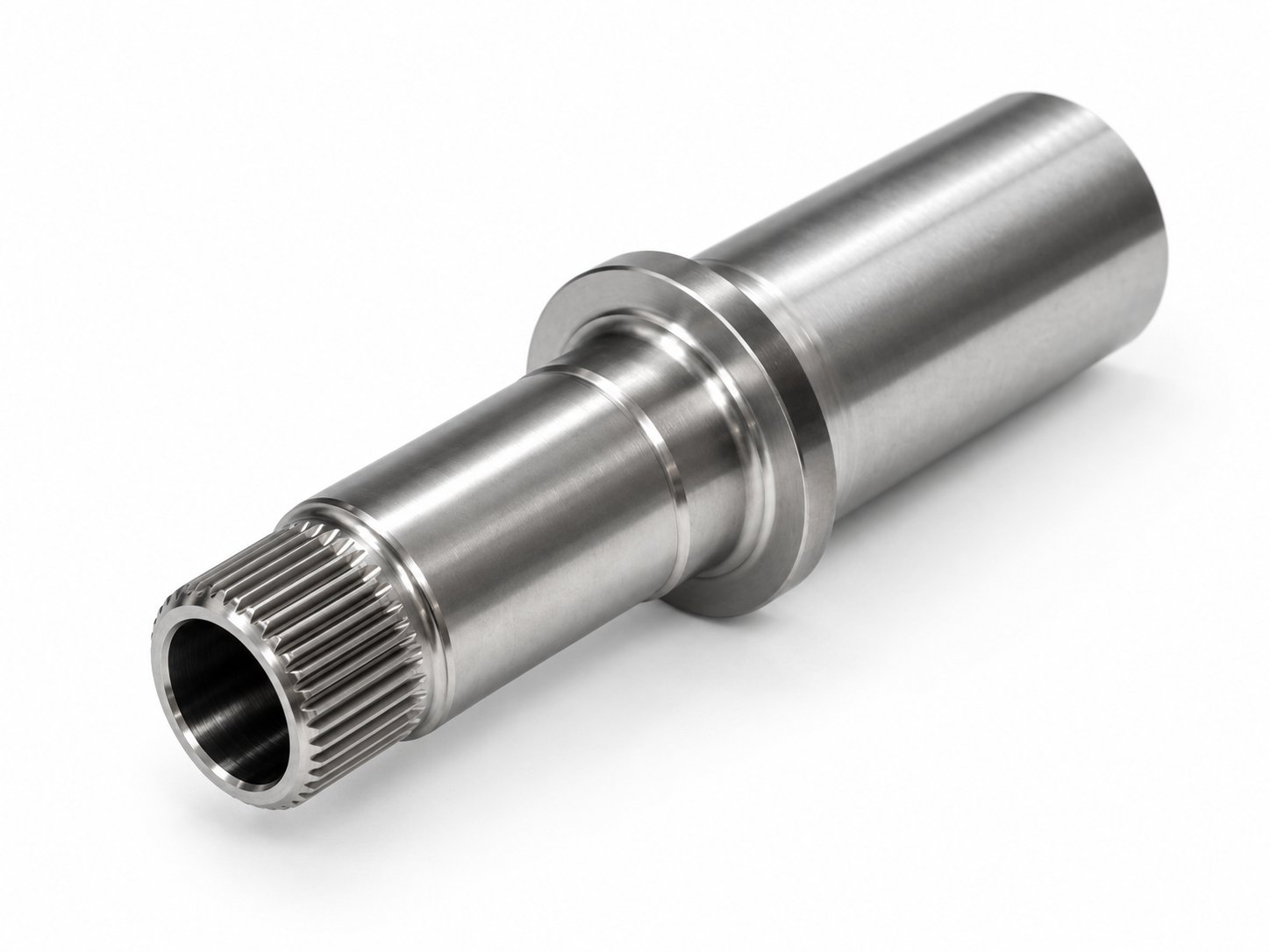
The challenge: producing a 90° shoulder by forming
One particular challenge in the hollow shaft developed was producing a 90° shoulder during the forming process. At the same time, a large step change in diameter had to be achieved with high geometric accuracy.
Several manufacturing processes work together to achieve this. Cold forming, turning, hardening and grinding form a coordinated process chain for the demanding component geometry.
Key features of the solution
- A 90° shoulder produced by forming
- A large step change in diameter with high geometric accuracy
- A combination of cold forming and targeted finishing operations
- A high degree of functional integration with reduced material use
This component illustrates that cost-effectiveness depends on a process chain tailored to the geometry, function and production volume, rather than on a single manufacturing process.
Why develop hollow shafts with Felss?
Felss specialises in the cold forming of tubes and solid material, combining component development, process expertise, machine construction and component manufacturing within one group of companies.
The aim is a cost-effective hollow shaft with a manufacturing process optimally suited to its intended function. With international production sites and a global sales and service network, Felss supports projects from development through to industrial series production.
Application in the electric motor of a servo steering system
In electromechanical steering systems, a hollow shaft can serve as the motor shaft of the electric actuator. It transmits the required forces or torque within the steering system, while its hollow design enables a compact, weight-optimised construction.
This application in particular requires several demands to be met at once. The shaft must be strong and precise, while keeping weight and installation space to a minimum and accommodating complex functional geometries.
The hollow shaft developed by Felss demonstrates the potential of a manufacturing strategy tailored to these requirements.
Discover more applications
Camshaft
Crash tube
Hollow shaft
Steering shaft

Manufacturing hollow shafts by cold forming
To manufacture hollow shafts cost-effectively, we combine our cold forming processes and supplement them with additional machining and processing steps where technically appropriate.
The process sequence depends on the component geometry, material, required tolerances, loads and planned production volume. Manufacturing is therefore always planned around the specific component.
Rotary swaging for lightweight, strong shafts
In rotary swaging , a tube is formed incrementally by rapidly repeated tool movements. This allows precise control of diameters, wall thicknesses and external contours.
Additional mandrels can create complex internal geometries at the same time. Cold forming strengthens the material, opening up further possibilities for lightweight components capable of withstanding high loads.
Depending on the component, rotary swaging at Felss can increase fatigue strength by up to 30% and reduce weight by up to 50%.
Splines produced by axial forming
If the hollow shaft requires splines to transmit force or torque, axial forming can complement the process chain.
The required profile is formed directly into the material. This makes it possible to produce internal and external splines as well as a range of spline profiles and special profiles. Felss achieves accuracy classes 5 to 6 in accordance with DIN 5480.
Where are hollow shafts used?
Hollow shafts are used wherever rotational motion or torque needs to be transmitted while reducing weight, installation space or moving masses. This makes them particularly relevant in the automotive industry and in machine and plant construction.
Electric motors and electric drives
In electric motors and electric drive systems, hollow shafts enable compact, weight-optimised shaft designs. Depending on its function, a rotor shaft, for example, can be designed as a hollow shaft.
Steering systems
In electromechanical steering systems, hollow shafts can be used as motor shafts or steering shafts. These applications require low mass, compact installation space, high load capacity and precise functional geometries.
Transmissions
Transmission shafts with a hollow design allow torque to be transmitted with reduced material use. Integrated splines, different diameters and wall thicknesses tailored to the loads offer additional design possibilities.
Drive systems
For drive shafts, a hollow design can be particularly useful where high mechanical loads need to be combined with a weight-optimised construction.
Do you have any questions or would you like some non-binding advice?
Do you have questions about our products and services and would like to find out more about Felss? Then do not hesitate to contact us! Our experts will be happy to advise you.

Forming or machining: what is the most cost-effective way to make a hollow shaft?
No single process is the most cost-effective choice for every hollow shaft. The deciding factors are component geometry, material, tolerances, functional requirements and production volume.
Cold forming for material-efficient series components
Cold forming is particularly suitable when material needs to be used efficiently and complex geometries need to be reproduced consistently in series production.
Rotary swaging shapes the existing material into the required geometry. At the same time, cold work hardening can offer further opportunities to improve the component’s mechanical properties.
Cold forming can offer economic advantages, particularly for components that would otherwise require large amounts of material to be removed by machining.
Machining for targeted processing steps
Machining processes such as turning or grinding offer considerable geometric flexibility and can be useful where specific surfaces, tolerances or functional areas require targeted machining.
At Felss, the focus is therefore on identifying the process sequence that provides the best solution for the specific component, rather than simply choosing between forming and machining.
The most cost-effective solution often combines processes
For demanding hollow shafts, cold forming is combined with complementary machining and processing operations. For example, cold forming can create the basic geometry and complex features, while other processes are used selectively to achieve the required final component quality.
What matters is therefore the process chain that best suits the hollow shaft, both technically and economically, rather than any single process.
Frequently asked questions about hollow shaft manufacturing
What is a hollow shaft?
A hollow shaft is a shaft with a cavity along its longitudinal axis. Like a solid shaft, it can transmit rotational motion and torque. Its hollow design, however, allows material and therefore weight to be reduced. At the same time, the internal space can be used in the design, and the geometry can be tailored to the loads acting on the component.
What advantages does a hollow shaft offer over a solid shaft?
The main advantage is the potential to reduce weight and material use. In a design tailored to the loads, material can be removed from areas where it contributes little to the component’s function. Depending on the geometry and application, this can reduce weight and inertia. Additional functions can also be integrated into the internal and external contours.
How are hollow shafts manufactured industrially?
Various processes are available for manufacturing hollow shafts. These include forming and machining processes, as well as combinations of several technologies. Felss focuses on cold forming processes such as rotary swaging and axial forming, combining them with other processes such as turning, hardening or grinding where required.
Why is rotary swaging suitable for manufacturing hollow shafts?
Rotary swaging forms the material incrementally and with high precision. Processing tube stock allows precise control of diameters, wall thicknesses and external contours. Mandrels can create complex internal geometries at the same time. Cold forming also results in cold work hardening of the material.
Can complex internal geometries be produced in a hollow shaft?
Yes. In rotary swaging, internal tools or mandrels can create defined internal contours during the forming process. Which geometries are technically and economically feasible depends on the specific component design.
Can hollow shafts be manufactured with internal or external splines?
Yes. The Felss axial forming process can produce both external and internal splines. A range of spline profiles and special geometries is also possible. Rotary swaging and axial forming can be combined within a single process chain.
When is cold forming more cost-effective than machining?
This depends on the component geometry, production volume, material, tolerances and extent of processing required. Cold forming can offer advantages in material use, processing time and component properties, particularly for series components that require extensive material removal or have functional geometries designed for forming.
Does Felss manufacture hollow shafts to customer specifications?
Yes. Felss component manufacturing can produce custom components from prototype through to series production. In addition to Felss cold forming technologies, further in-house processes are available for complete component processing.
Does Felss also supply machines for in-house hollow shaft production?
In addition to component manufacturing, Felss develops and builds machines and systems for cold forming. The process and machine solution is developed around the specific component and can include rotary swaging, axial forming or other Felss technologies, for example.
Internationally positioned
Around the world: Felss produces sophisticated components of the highest quality and precision at five locations worldwide. With our plants in Germany, Switzerland, the USA, China and Slovakia, we are your global partner and you can benefit from the transfer of know-how within our group.

Your added value with Felss
Felss stands for smart, customized solutions in cold forming. Our aim is to offer you real added value with our machines, components and services.
- Lightweight , weight-optimized use of materials thanks to intelligent material distribution.
- More resilient Improved component performance through targeted control of material properties.
- Resource-efficient waste avoidance and full material utilization through cold forming.
- Faster Shorter production times and optimized workflows thanks to innovative processes.
- More precise Highest accuracy of complex geometries thanks to Felss technologies.
- Tailor-made Optimal solutions, tailored to your individual requirements.

Come to us as early as the development phase of your projects
We support you throughout the entire process – from the drawing to the finished component and beyond.