From Cost Factor to Competitive Advantage: An Efficient Process Chain for Rotor Shafts
Felss leverages its core competencies in rotary swaging and axial forming to manufacture thick-walled rotor shafts, which offers an advantage, especially in lightweight construction.
Economic pressure changes the manufacturing
The automotive industry is currently facing an environment characterized by economic restraint. Rising energy and production costs, volatile sales markets, and an overall hesitant investment climate are forcing manufacturers and suppliers to critically reassess their existing production processes. Today, production solutions must not only be technically high-performing but also cost-effective, energy-efficient, and designed to serve as reliable long-term investments.
Rotor shafts present challenges for conventional processes
Rotor shafts play a central role in electric drive systems and are subject to increasing power and torque requirements, along with growing demands for dimensional accuracy and component quality. Conventional machining processes are reaching their limits, especially for hollow or thick-walled rotor shafts due to high material removal rates, long machining times, and correspondingly high energy consumption. In addition to economic disadvantages, this also negatively impacts the product carbon footprint of the components.
Forming instead of machining: the Felss solution
With over 120 years of experience in cold forming, the Felss Group addresses these challenges as a machine manufacturer and process developer through its core technologies of rotary swaging and axial forming. By specifically combining both processes, a rotor shaft geometry optimized for function and manufacturability was designed from a tubular product (figure 1), meeting current requirements for lightweight design and functionality.
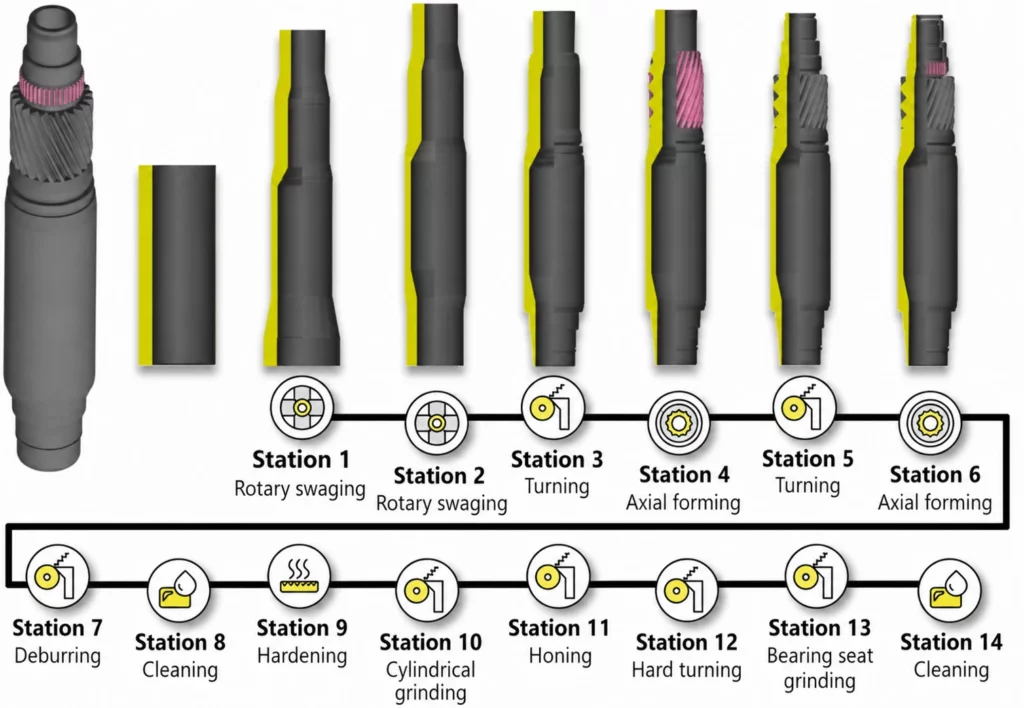
Figure 1
Load-based material distribution for improved efficiency
A load-oriented wall thickness distribution enables high geometric precision and structural efficiency, while the integrated helical gearing ensures safe and reliable torque transmission even at high rotational speeds. The mainly cold metal forming process across station 1 through 6 enables high material utilization without the need for heating, thereby minimizing unnecessary energy and material losses. As a result, significant savings potential in material consumption, energy use, and CO₂ emissions can be achieved compared to conventional machining solutions.
High-strength materials
The increasing demands placed on modern high-performance rotor shafts, along with the growing use of higher-strength materials, are steadily pushing the process window of existing rotary swaging machines toward their upper capacity limits. Felss has developed the Generation E10 rotary swaging machine, as achieving higher component accuracy at these performance limits is only possible with considerable more effort due to dynamic effects and vibration.
Generation E10: Rotary Swaging for Demanding Production Processes
The machine was specifically designed for demanding production applications that require the highest levels of precision, process stability, and energy efficiency. At the center of the design is a 6-jaw forming unit with a total forming force of up to 6,000 kN and forming frequencies of up to 50 Hz (Figure 2). The main advancements focus on the electric drive technology, which offers more precise control, higher dynamics, and improved reproducibility of the forming processes while simultaneously reducing energy consumption compared to hydraulically dominated systems. In addition, the machine structure was designed to be more resistant to dynamic loads and vibrations, which has a direct positive effect on the achievable component quality.
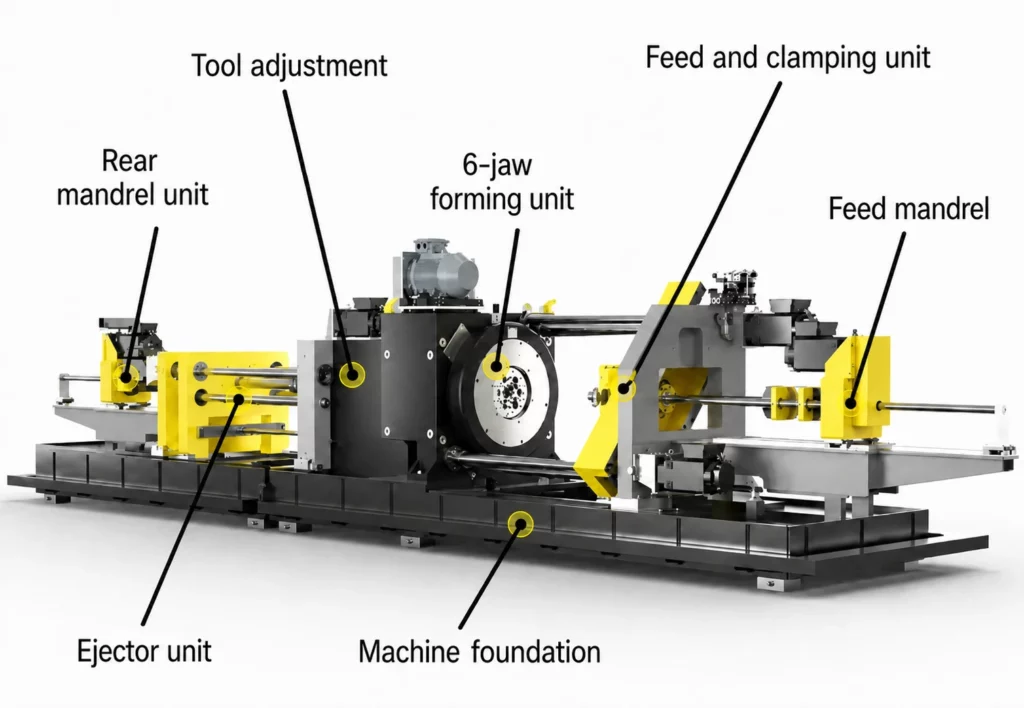
Figure 2
The modular design of the Generation E10 simplifies maintenance and retrofitting while enabling precise adaptation to different geometries, materials, and production volumes. Felss provides the foundation for integrating rotary swaging processes into industrial series production in a safe, economical, and resource-efficient manner, as well as for flexibly combining them with downstream forming technologies such as axial forming. The Generation E10 thus represents a key element of efficient and sustainable process chains in rotor shaft manufacturing.
Axial Forming for high-performance final geometries
In addition to rotary swaging, axial forming plays a crucial role in rotor shaft manufacturing, especially in the production of high-performance final geometries. With increasing torque requirements, helical gears are increasingly used to ensure reliable power transmission, which in industrial practice are often manufactured by machining processes such as gear hobbing. To integrate this process step into the forming-based process chain, axial forming has been specifically further developed at Felss.
New machine generation for Helical Gears
The development result is a new generation of machines for axial forming, specifically designed to produce helical gears through forming, that combines the advantages of hydraulic and electrical drive technology (figure 3). The necessary axial forming force is generated by a hydraulically actuated ram. A specially designed bearing arrangement ensures that the tool holder is guided without rotational play, even under maximum load. The rotational motion required for the forming process is provided by a backlash -free drive system, that consists of a servo engine and a gearbox, which enables high torque, high dynamics, and positional accuracy. In addition, the machine is equipped with a selectable clutch that allows rotational freedom.

Figure 3
Therefore, the tool can be withdrawn from the gear forming operation with barely any force, what significantly reduces wear on the tool and component and supports a stable, repeatable process control.
Engineering
The development process confirmed that the higher torque stiffness of the press frame, the exact synchronization of the axis, and the high-performance tool bearing enables a stable, reproducible process window. Trials validated the reliable forming of helical gearing over a wide range of different helical angles. With an optimized blank geometry and appropriate process control, it is possible to manufacture precise helical gear, where elastic deformation is specifically compensated. Further details are referred to publications [1-3].
CO₂ balance: Efficiency becomes measurable
By combining the electrified rotary swaging with the advanced axial forming, it is primarily possible to manufacture rotor shafts by forming. The environmental potential for the CO₂ balance of the process chain has been examined by using the FRED tool. A machining process route alternative was used for reference. The analysis of the relevant process steps shows a reduction of CO₂-emissions of above 60%, approximately 4 kg CO₂ per rotor shaft. Assuming an annual volume of 200.000 components, this results in a total saving of 800 t CO₂ per component variant.
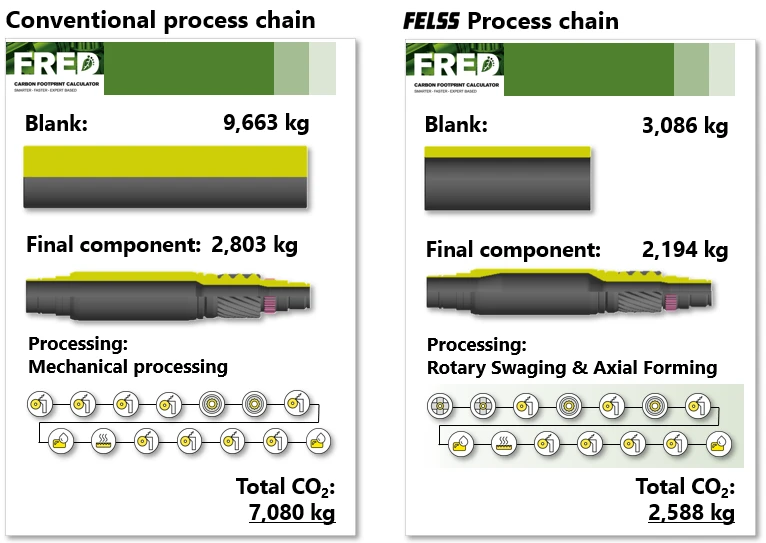
Figure 4
From process to competitive advantage
The targeted development of rotary swaging and axial forming machines enables Felss a cost-effective, precise and resource-efficient manufacturing of rotor shafts that supports users to remain competitive in challenging market conditions.
References
[1] Missal, N.; Schwertel, S.: Schrägverzahnungen durch Axialformen: Neue und nachhaltige Wege in der Massivumformung. massivUMFORMUNG Ausgabe 04/2024, S.27-31, Industrieverband Massivumformung e.V., Hagen, 2024, ISSN 2366-5106
[2] Missal, N.; Schwertel, S.: Innovative cold metal forming processes for a sustainable future – Moving forward with helical gear drive components in a resource and energy-efficient way. Dritev 2023, VDI-Berichte Band 2420, S.295-306, VDI-Verlag, Düsseldorf, 2023, https://doi.org/10.51202/9783181024201
[3] Missal, N; Schwertel, S.; Ludwig, M.: The next level of axial forming for a sustainable component and process chain design. Tagungsband International Conference on Gears 2023, VDI-Berichte Band 2422, S.1765-1776, VDI-Verlag, Düsseldorf, 2023, http://dx.doi.org/10.51202/9783181024225-1765