Bending
Bending is one of the most important forming processes in industrial metalworking. A workpiece is deliberately and permanently shaped through plastic deformation without removing any material.
Bending as a forming process
DIN 8586 defines bending as the forming of a solid body in which the plastic state is primarily produced by bending stress.
DIN 8586 generally distinguishes between:
- Bending with linear tool movement
- Bending with rotary tool movement
This classification forms the basis of many industrial bending processes.
Bending in industrial manufacturing
Bending is used across numerous industrial sectors, ranging from mechanical engineering and automotive engineering to aerospace. Typical workpieces include:
- Tubes
- Profiles
- Sheets
- Bars
- Strips
- Wires
Different bending processes are used depending on the material, cross-section, wall thickness and required geometry.
What is bending technology?
Unlike machining processes such as milling or turning, bending does not remove any material. Instead, the material is permanently deformed through the controlled application of force.
During the bending process, the material undergoes both elastic and plastic deformation. The new shape of the component only becomes permanent once plastic deformation begins.
What types of bending are there?
Bending encompasses various applications that differ primarily according to the geometry of the workpiece and the type of semi-finished product used. In industrial practice, a distinction is often made between sheet metal bending and tube and profile bending.
Sheet metal bending
Sheet metal bending is one of the most commonly used processes in industrial forming technology. It is mainly used to process flat workpieces such as sheets, strips and wires. Sheet metal bent parts are used, for example, in enclosure manufacturing, mechanical engineering, tank construction and vehicle production.
Typical sheet metal bending processes include:
- Air bending
- Die bending
- Folding
- Roll bending
Tube and profile bending
Tube and profile bending involves the forming of tubes, profiles and other profiled cross-sections. Unlike sheet metal bending, the main focus is on controlling the cross-section and preventing ovalisation, wrinkling or wall thinning.
Tube and profile bending are deliberately considered together in forming technology because many of the processes overlap from a technical perspective and are based on the same mechanical principles. Numerous bending processes can be used for both tubes and a wide range of profile cross-sections. The differences depend on the geometry, wall thickness, material and the requirements of the subsequent application.
The following sections therefore take a closer look at the most important tube and profile bending processes, as these play a central role in Felss’ industrial applications.
What methods are used in tube bending?
Tube bending methods can generally be divided into two groups according to the way the contour is created: form-bound tube bending methods and methods with a kinematic definition of the bending contour. The decisive factor here is whether the resulting bend geometry is created predominantly by the shape of a tool or by the movement of the tools during the process.
Form-bound tube bending processes
In form-bound processes, the required bending contour is largely defined by the geometry of the tool. These processes offer high precision and are used particularly for tight bending radii and complex tube geometries.
Form-bound tube bending processes include:
- Stretch bending
- Circular bending
- Conventional tube bending
- Rotary draw bending
- Press bending
- Bending under internal pressure
- Hamburg process
- Axial roll bending into a die
Tube bending processes with a kinematically defined bending contour
In processes with a kinematically defined bending contour, the geometry is created through the controlled movement of the tools or rollers during the forming process. This makes it possible to produce different radii and geometries flexibly.
Processes in this group include:
- Roll bending/three-roll bending
- Bending with superimposed torsion
- Incremental tube forming
- Moment-controlled bending
- Freeform bending with a sliding guide
- Bending with expansion
The process selected depends on factors such as the material, tube diameter, bending radius and production volume. The following sections examine selected tube bending processes in greater detail.
Tube bending processes in detail
The choice of a suitable tube bending process depends, among other factors, on whether tight or large bending radii are required and on the requirements concerning surface quality, repeatability and cross-sectional stability.
The following sections explain two tube bending processes used by Felss in greater detail: rotary draw bending and roll bending.
Rotary draw bending
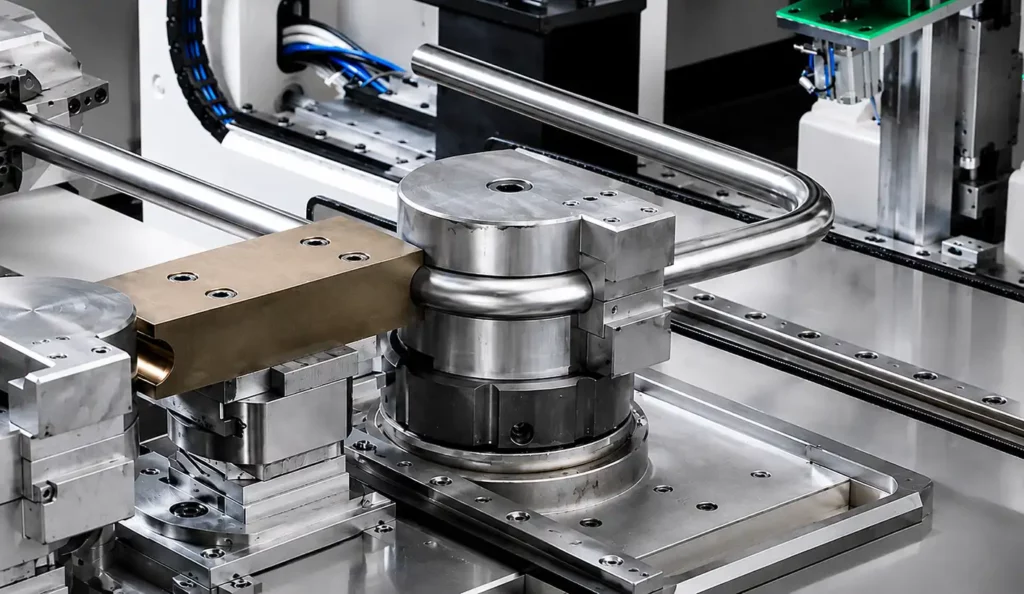
Rotary draw bending is one of the most important form-bound tube bending processes. The tube is secured in a bending die and drawn around it in a controlled manner to produce the required radius. The final geometry is largely determined by the tool contour.
Additional tools such as mandrels or wiper dies are frequently used to reduce deformation of the cross-section. This makes the process particularly suitable for:
- Tight bending radii
- Thin-walled tubes
- Complex tube geometries
- High dimensional accuracy
Rotary draw bending is used in industries including automotive manufacturing, aerospace, plant engineering and mechanical engineering. Felss also uses the term rotary-draw bending for this process on its English-language CBC machine page.
The following video illustrates the basic principle of rotary draw bending:
Tube bending using roll bending
Roller bending, also known as roll bending, is one of the tube bending processes in which the bending contour is defined kinematically. The required geometry is created through the controlled movement of several rollers during the forming process.
Roll-based bending processes are among the most widely used methods for producing large radii. The workpiece is gradually plastically deformed between several rollers, allowing continuous curves and large bending radii to be produced.
The following video provides a simplified illustration of the roll bending process:
Three-roll bending
The machine concept most commonly used in industrial practice within this group of processes is three-roll bending. The adjustable positioning of the rollers enables different tube and profile geometries to be produced economically and reproducibly.
Roll bending processes are particularly suitable for:
- Large bending radii
- Long workpieces
- Tubes and profiles
- Continuous curves
- Cost-effective series production
Typical applications include structural components, piping systems and solutions used in vehicle manufacturing, plant engineering and steel construction.
Bending machines in industrial production
Specialised bending machines are used in industrial production to implement bending processes efficiently and with consistent results. They enable precise control of the forming forces and a high level of repeatability.
Different machine types are used depending on the workpiece and process. Modern systems are often automated and can produce complex bending geometries with a high degree of process stability.
Felss bending machines and technologies
At Felss, we use a range of technologies and machine solutions to carry out bending and forming processes with precision. Different machine types are used depending on the application.
Tube bending machine
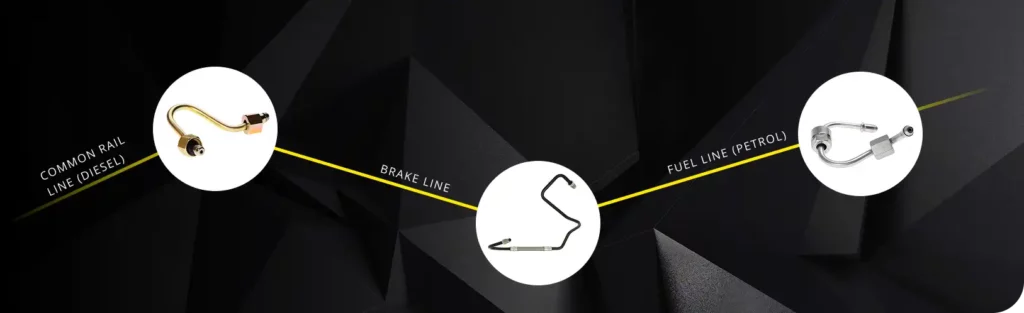
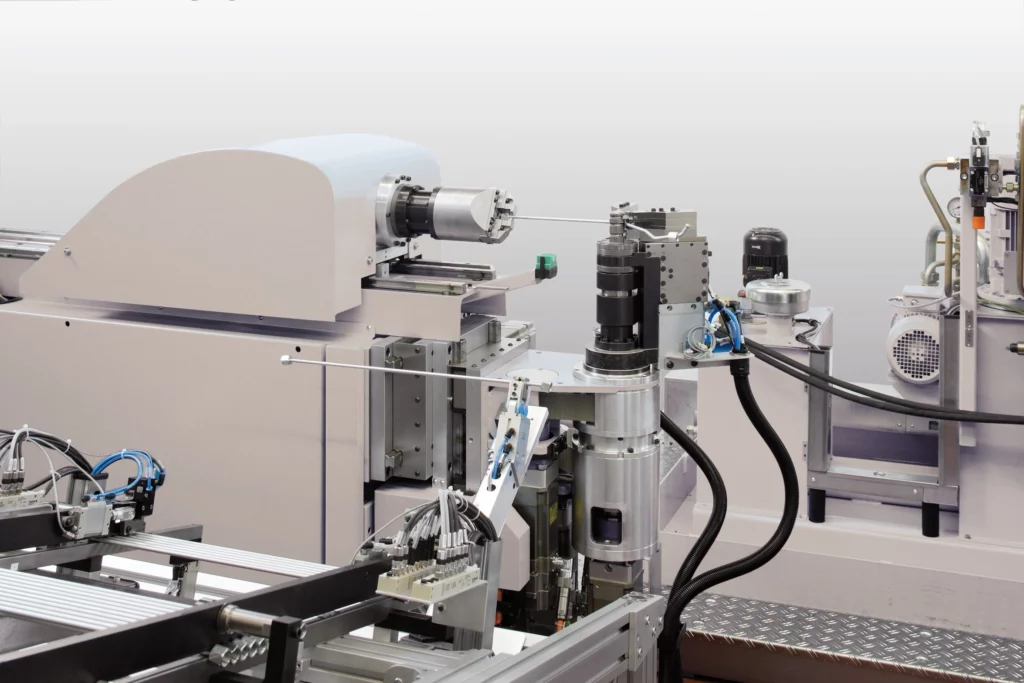
Felss tube bending machines have a modular design and enable complex tube geometries to be produced flexibly, for example for brake lines, fuel lines and heat exchanger tubes. By combining several bending processes, such as rotary draw bending and roll bending, even demanding tube geometries with short straight sections between the bends can be achieved.
Bending and punching machine
Bending and punching machines are frequently used to process flat metal parts. These systems combine punching and bending processes in a single machine, enabling the cost-effective series production of complex components from strip material.
At Felss, this task is performed by the Flat Blade Bending Machine FBC, which was specially developed for the precise forming of flat workpieces. Its patented bending technology ensures outstanding bending quality and dimensional stability.
End machining machine
In addition to its bending machines, Felss offers end machining technologies for producing highly precise tube ends. The end machining machines ensure exact part positioning, resulting in high repeatability and consistent component quality.
This enables the production of reliable connections for common rail, fuel and brake lines used in automotive engineering and industrial applications.